When I went to my first romance writers' conference, I didn't know anybody. I'd never even met another romance writer. One of the people I met was Jennie Adams, who was wonderful and introduced me to others and made me feel welcome and included. Jennie and I also met up again at the RWAus conference in Melbourne last year, and have maintained a great online friendship.
Jennie's first books for Harl/Sil were published in Australia last year, but the first one to be published in the US only came out this month - The Boss's Convenient Bride.
Today, I found out that The Boss's Convenient Bride is #10 on this week's Waldenbooks Romance Bestseller's list.
WOOOOOO-HOOOOOO JENNIE!!!!
It's a great book, and so it's no wonder it's doing well. And the author is such a wonderful, generous person as well as being an excellent writer. Well done, Jennie! It's definitely a day to wave that pink feather boa around!
Tuesday, September 19, 2006

Monday, September 11, 2006
Updated look
I've just updated the look of the blog - I was getting a little bored with the old theme, and at least this one has some colour similarity to my web page. I was trying to edit the stylesheet to include some of the photos from my web page, and make the designs more similar, but it was too hard after a long day at work, especially given that CSS and I have only a nodding acquaintance!
I may do some more changes later, when I'm not so tired. In the meantime, I'm off to bed - it will be another busy day at work tomorrow.
I may do some more changes later, when I'm not so tired. In the meantime, I'm off to bed - it will be another busy day at work tomorrow.
Sunday, September 03, 2006
Golden Anniversary
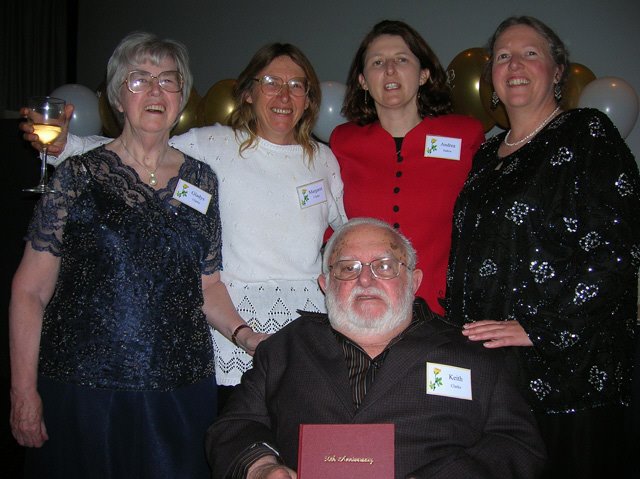
My parents celebrated their 50th wedding anniversary on Friday night. It was a wonderful night, with 50 or so friends and family including cousins I haven't seen for many years who travelled from Melbourne for the event. The photo above is my parents with my sisters and I. (I'm the one who looks just like my Mum!)
My folks are two very special, amazing, and inspirational people and it was a great joy to celebrate their anniversary with them.
And, yes, they're a significant contributing factor to me writing romance :-)
Sunday, August 27, 2006
I'm back...
We returned home this afternoon after just over two weeks away in the eastern Outback. It was a great trip - great company, fantastic weather almost the whole way, and amazing landscape - but I'm a bit too tired tonight to try and write anything intelligent about it!
Keep an eye on the photoblog - I'll put some pictures up over the next few days.
Keep an eye on the photoblog - I'll put some pictures up over the next few days.
Sunday, August 06, 2006
Kookaburras and old gum trees.
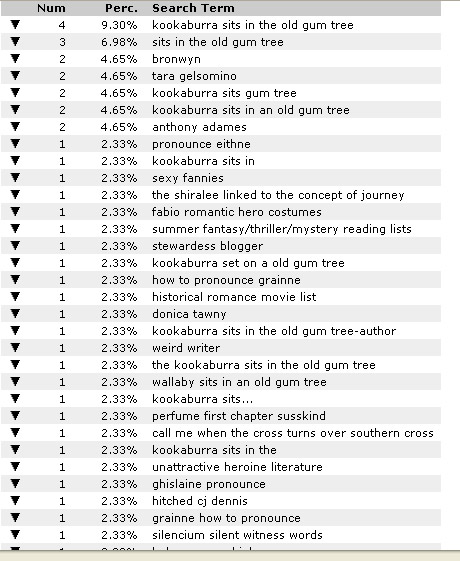
There you go. I've obviously hit the big time of some strange cult following, since 18% of the last 100 searches that brought people to my blog are for some variant of 'kookaburra sits in the old gum tree.' I've been noticing this for a while, actually - ever since I made a post with that title. People from all over the world - the US, UK, Europe, Japan, are searching for kookaburras and old gum trees and finding their way to the post on my blog.
Don't get me wrong - I love having people visit my blog. Anyone (other than spammers and psychotics) is welcome here. I'm just fascinated as to why so many people are searching for the song. School projects? Camp songs? Or has it attained some cult status and meaning that I'm innocently unaware of?
We used to sing it in rounds, when we were kids. It passed some of the time when going on long car trips in the days before car radios, and I much preferred to 'Three Blind Mice'.
Anyway, here are the words, for those searching for them:
Kookaburra sits in the old gum tree,
Merry, merry king of the bush is he,
Laugh, kookaburra, laugh, kookaburra,
Gay your life must be.
Hmmm... they've probably changed the words in recent decades, since 'gay' has changed it's meaning. But that's what we used to sing. So, all you Kookaburra seeking blog visitors, please feel free to comment about what you're looking for.
Wednesday, August 02, 2006
Catching up (yet again)
Okay, so it's been quiet here lately. What have I been up to these past few weeks? Apart from the normal work/life stuff, I've been:
- dealing with a bad shoulder, which meant limiting my computer work
- spending limited computer time writing
- planning our Outback trip
- making lists for our trip
- shopping for our trip (food, emergency supplies, first aid gear, equipment etc)
- trying to work out how to organise and pack all the stuff into the truck
Sunday, July 09, 2006
Painted warp
I suggested that our Spinners and Weavers Guild have a 'Something New' Challenge for the rest of the year - participants to try out a technique new to them, write a report for the newsletter, and everyone who participates goes into the draw at the end of the year for a voucher for a fibre or yarn supplier.
So, to provide a first example to the guild, I decided to try out painting a warp, something I've not done before. I wound the warp this morning - a fine white wool - and I ended up going into our guild rooms this afternoon to dye it as it's much better set up for laying out long warps, plus the microwave and dyeing equipment is all there.

I'm quite happy with the outcome, particularly given that my dye mixing was definitely not scientific! There's enough to make two scarves, each one going from red through purple and blue to green and then back out to red again. Now I just have to wait until it's dry, then put it on the loom, then decide what pattern and colours to use in the weft and do the weaving. That's all ;-) In all that spare time that I have...
So, to provide a first example to the guild, I decided to try out painting a warp, something I've not done before. I wound the warp this morning - a fine white wool - and I ended up going into our guild rooms this afternoon to dye it as it's much better set up for laying out long warps, plus the microwave and dyeing equipment is all there.
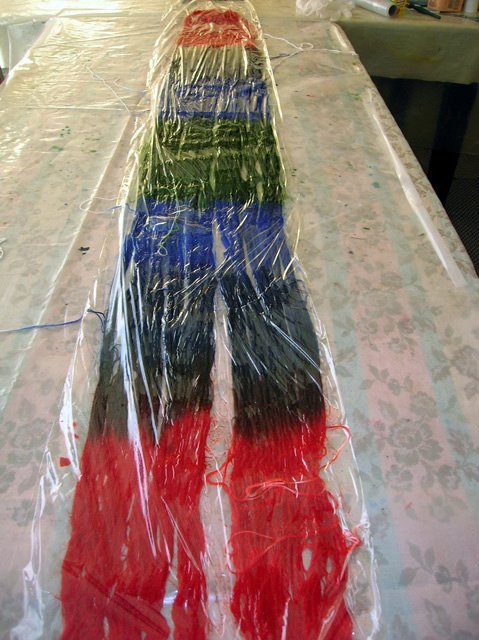
I'm quite happy with the outcome, particularly given that my dye mixing was definitely not scientific! There's enough to make two scarves, each one going from red through purple and blue to green and then back out to red again. Now I just have to wait until it's dry, then put it on the loom, then decide what pattern and colours to use in the weft and do the weaving. That's all ;-) In all that spare time that I have...
The Ancient Art of Par-King.
(Procrastination hit this morning, and I was inspired to write this for my batty writers' group after some discussion about the terrors of parking.)
The Ancient Art of Par-King.
The origins of this art-form are lost in the sands of time. Earliest recordings are found in Asian poetry scrolls dating to 1000BCE, where Par-King appears to have been practised by court poets near lakeside views. It is said that some poets entered a prolonged trance state while Par-King that could last for weeks.
As with many adoptions from the East, the artform appeared in the Mediterranean during the early Roman period. The Romans, however, turned it into a competitive sport, with competition amongst chariot drivers for Par-King spaces in the centre of Rome rivalling that of the Gladatorial contests in the Arena. Par-King differed from the Gladitorial contests in one key aspect; it actively involved spectators, who paid for the privalege of riding with the chariot drivers while they Par'K'd and who could become as aggressive and combatitive in defending a Par-King place as the drivers themselves.
The practice of Par-King ebbed and flowed during the Dark and Middle Ages, with many regional variations evolving. (The Venetians, for example, used boats.) Popularity again soared from the eighteenth century onwards, when large proportions of the populace across Europe moved to the rapidly growing cities. The competitive version of Par-King has always been more widely practised in metropolitan areas, whereas rural areas - particularly isolated rural areas - maintained the original, meditative art-form. (Except on market days, when a friendly, informal version of the sport was played, usually with much good-natured humor.)
In the modern era, high-stakes Par-King contests are conducted every day across much of Europe, North America, and in major cities in Asia. Participation in the sport of Par-King is higher than in any other sport, involving some 70% of the population on a daily basis. Competition has grown so fierce in some places that the competitors spend vast sums on large vehicles to terrorise competitors in smaller ones, and injuries, while still relatively rare given the vast number of players, do occur. Elitism has also entered the sport, with some competitors paying large daily sums to compete on less-crowded Par-King fields.
Sadly, it is only in the backwaters of modern life - rural communities, and some small towns - that Par-King is still practised in its original art form, as a joyful, meditative practice. While some urban youth do practice a version of Par-King - in pairs, in dimly lit areas at night - adherents of the old ways consider the limitation to pairs in the night-time to be a corruption of The True Practice of Par-King, which, they say, should be able to be undertaken by any devotee, at any time.
The Ancient Art of Par-King.
The origins of this art-form are lost in the sands of time. Earliest recordings are found in Asian poetry scrolls dating to 1000BCE, where Par-King appears to have been practised by court poets near lakeside views. It is said that some poets entered a prolonged trance state while Par-King that could last for weeks.
As with many adoptions from the East, the artform appeared in the Mediterranean during the early Roman period. The Romans, however, turned it into a competitive sport, with competition amongst chariot drivers for Par-King spaces in the centre of Rome rivalling that of the Gladatorial contests in the Arena. Par-King differed from the Gladitorial contests in one key aspect; it actively involved spectators, who paid for the privalege of riding with the chariot drivers while they Par'K'd and who could become as aggressive and combatitive in defending a Par-King place as the drivers themselves.
The practice of Par-King ebbed and flowed during the Dark and Middle Ages, with many regional variations evolving. (The Venetians, for example, used boats.) Popularity again soared from the eighteenth century onwards, when large proportions of the populace across Europe moved to the rapidly growing cities. The competitive version of Par-King has always been more widely practised in metropolitan areas, whereas rural areas - particularly isolated rural areas - maintained the original, meditative art-form. (Except on market days, when a friendly, informal version of the sport was played, usually with much good-natured humor.)
In the modern era, high-stakes Par-King contests are conducted every day across much of Europe, North America, and in major cities in Asia. Participation in the sport of Par-King is higher than in any other sport, involving some 70% of the population on a daily basis. Competition has grown so fierce in some places that the competitors spend vast sums on large vehicles to terrorise competitors in smaller ones, and injuries, while still relatively rare given the vast number of players, do occur. Elitism has also entered the sport, with some competitors paying large daily sums to compete on less-crowded Par-King fields.
Sadly, it is only in the backwaters of modern life - rural communities, and some small towns - that Par-King is still practised in its original art form, as a joyful, meditative practice. While some urban youth do practice a version of Par-King - in pairs, in dimly lit areas at night - adherents of the old ways consider the limitation to pairs in the night-time to be a corruption of The True Practice of Par-King, which, they say, should be able to be undertaken by any devotee, at any time.
Monday, July 03, 2006
Out and about
We had a great trip with friends on Saturday down to part of the Oxley Wild Rivers National Park. A wilderness area, gorgeous scenery, good company - what more can anyone ask for?*

After enjoying the view from the lookout at Budds Mare, we then drove along a 4WD only access track down the escarpment to the Riverside camping area on the Apsley River, nestled in the narrow valley. There we boiled the billy and had morning tea in glorious winter sunshine, then went for a mild bushwalk, then picnic lunch. We didn't see a lot of wildlife, but there were tree-creepers on the nearby trees, and a wallaby munched happily 100m or so away from us. We had the place to ourselves otherwise - not another soul for miles around.
Sunday afternoon saw another short excursion into the landscape - DH and I took the dogs over to Bakers Creek Falls, at the top of the Metz Gorge, the nearest part of the vast New England escarpment to our place (only about 5km as the crow flies.) So we had a pleasant walk along the road there, and the dogs had a great time exploring a new place - lots of exciting smells to sniff, although once again we didn't see anyone else. A pleasant stroll in a country lane with stunning views off to one side... life is indeed rich!
*Other than wealth, copious quantities of chocolate, time to write, and a large publishing contract.
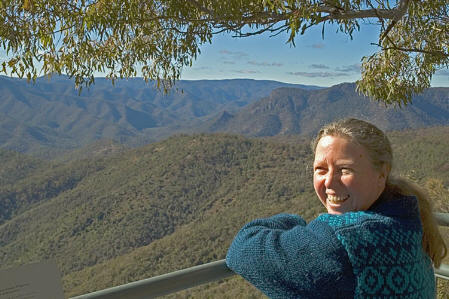
After enjoying the view from the lookout at Budds Mare, we then drove along a 4WD only access track down the escarpment to the Riverside camping area on the Apsley River, nestled in the narrow valley. There we boiled the billy and had morning tea in glorious winter sunshine, then went for a mild bushwalk, then picnic lunch. We didn't see a lot of wildlife, but there were tree-creepers on the nearby trees, and a wallaby munched happily 100m or so away from us. We had the place to ourselves otherwise - not another soul for miles around.
Sunday afternoon saw another short excursion into the landscape - DH and I took the dogs over to Bakers Creek Falls, at the top of the Metz Gorge, the nearest part of the vast New England escarpment to our place (only about 5km as the crow flies.) So we had a pleasant walk along the road there, and the dogs had a great time exploring a new place - lots of exciting smells to sniff, although once again we didn't see anyone else. A pleasant stroll in a country lane with stunning views off to one side... life is indeed rich!
*Other than wealth, copious quantities of chocolate, time to write, and a large publishing contract.
Thursday, June 29, 2006
Historical resources
I finally remembered to put a link in the sidebar to the Historical Resources for Romance Writers wiki that I set up a while ago. I haven't done a lot with it yet, but I updated a few things today and realised that despite me not spreading the word about it much, there's been 300+ visitors to it in the past few months. Nobody's added anything yet, but I hope I made the invitation to do so a little more obvious in my minor edits today.
So, don't make me feel all alone and unloved in the webiverse. If you've got interesting information about anything historical that might interest romance writers, go and add it!
(Yes, Kate, that includes you. You know lots of interesting stuff - like food, and photography, and NY police.)
And talking of hysterical stuff, we watched the DVD of 'The Mists of Avalon' a week or two ago. That spinning wheel in the opening scene?? About 1,000 years before its time. Spinning wheels didn't come to western Europe until about the 11th century - and treadle wheels like the one in the film were a 15th century development.
Yes, yes, I gnashed my teeth. Wonder if I could make a living advising movie makers on historical spinning and weaving...
So, don't make me feel all alone and unloved in the webiverse. If you've got interesting information about anything historical that might interest romance writers, go and add it!
(Yes, Kate, that includes you. You know lots of interesting stuff - like food, and photography, and NY police.)
And talking of hysterical stuff, we watched the DVD of 'The Mists of Avalon' a week or two ago. That spinning wheel in the opening scene?? About 1,000 years before its time. Spinning wheels didn't come to western Europe until about the 11th century - and treadle wheels like the one in the film were a 15th century development.
Yes, yes, I gnashed my teeth. Wonder if I could make a living advising movie makers on historical spinning and weaving...
Tuesday, June 27, 2006
Adverbs - A podcast experiment
In my day job, I work with academics, assisting them in developing online teaching materials. So, I need to make sure I know how to do things, in order to assist them.
I've been experimenting with making short, teaching podcasts, so I recorded a podcast on using adverbs in writing. If you'd like to, you can listen to it here (2.47MB, 5:24minutes).
It's mostly aimed at early career writers. I may record a series of podcasts on aspects of writing, if anyone thinks it's worthwhile. Feedback's welcome - just post it in the comments. I know it's far from perfect, and I'd like to know what works and doesn't, so I definitely won't throw a hissy fit about constructive criticism! (Yep, I talk a bit fast in the last half.)
I've been experimenting with making short, teaching podcasts, so I recorded a podcast on using adverbs in writing. If you'd like to, you can listen to it here (2.47MB, 5:24minutes).
It's mostly aimed at early career writers. I may record a series of podcasts on aspects of writing, if anyone thinks it's worthwhile. Feedback's welcome - just post it in the comments. I know it's far from perfect, and I'd like to know what works and doesn't, so I definitely won't throw a hissy fit about constructive criticism! (Yep, I talk a bit fast in the last half.)
Wednesday, June 21, 2006
Honeyeaters
I've been sick lately, so there hasn't been much to blog about. But this morning my mood lifted when I looked out the kitchen window to the tangle that is called 'the herb garden' and saw that our little Eastern Spinebill Honeyeaters are back. There were about six of them, flitting in and out of the tree and into the 'garden', feeding on the rosemary flowers.

We don't have them all year; it seems that they follow the flowering plants around the region. Why we get them in winter, I've never quite worked out, but in previous years they've fed on a pineapple sage that we've had growing, which flowers in winter. Unfortunately, the sage has few flowers this year - just as well the rosemary has grown up enough to have some!
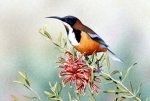
We don't have them all year; it seems that they follow the flowering plants around the region. Why we get them in winter, I've never quite worked out, but in previous years they've fed on a pineapple sage that we've had growing, which flowers in winter. Unfortunately, the sage has few flowers this year - just as well the rosemary has grown up enough to have some!
Monday, June 05, 2006
Old English, new English
I'm looking for a word for 'envoy' that isn't French in origin. Envoy, ambassador, emissary - they're all Frenchy. I'm fiddling with an idea for a Viking/Saxon historical, and seeing if I could do it without any of those new-fangled French words that the Normans brought later.
I suppose I could write it all in Old English (I did study it for a while at university), but, well, there might be a limited market for that ;-) And I'm not going to write it in any form of fake romancelandia dialect (cringe!); I just want to convey a sense of the language, through word choice and rhythm.
So, I'm trying to avoid obviously French words for things important to the plot. Words like, you know, 'marriage'. Which, for a romance, may be something of a challenge.
Fortunately, 'wife' and 'man' have their roots in good old Anglo-Saxon, as do an assortment of words related to sex in its rawer forms. But finding an equivalent for 'envoy' currently has me stumped.
I can see, if I ever decide to actually write this book, that I'll have to go and re-read some Old English... just as well I never threw out all those text books!
I suppose I could write it all in Old English (I did study it for a while at university), but, well, there might be a limited market for that ;-) And I'm not going to write it in any form of fake romancelandia dialect (cringe!); I just want to convey a sense of the language, through word choice and rhythm.
So, I'm trying to avoid obviously French words for things important to the plot. Words like, you know, 'marriage'. Which, for a romance, may be something of a challenge.
Fortunately, 'wife' and 'man' have their roots in good old Anglo-Saxon, as do an assortment of words related to sex in its rawer forms. But finding an equivalent for 'envoy' currently has me stumped.
I can see, if I ever decide to actually write this book, that I'll have to go and re-read some Old English... just as well I never threw out all those text books!
Sunday, June 04, 2006
A bit of fun
Wow. I'm famous. Or maybe that's infamous.
We had a bit of fun today on one of my writer's loops, and the Bat Dame herself (aka the amazing Ann Wesley Hardin) thought my contribution was amusing and copied it to her blog.
That's me - the occasional rare moment of brilliance, interspersed with interminably long periods of boring inanity.
sigh
I'd copy it here, but the Dame's blog is much more interesting than mine, so you should go over there and read it. Read her books, too - they're great.
I will however comment here (purely to a. get you to go and read the whole thing, and b. get an increase in my stats), that I probably should have added 'premature ejaculation', 'disappointment' and 'regret' to the definition.
And no, I am not referring to my love life ;-)
We had a bit of fun today on one of my writer's loops, and the Bat Dame herself (aka the amazing Ann Wesley Hardin) thought my contribution was amusing and copied it to her blog.
That's me - the occasional rare moment of brilliance, interspersed with interminably long periods of boring inanity.
sigh
I'd copy it here, but the Dame's blog is much more interesting than mine, so you should go over there and read it. Read her books, too - they're great.
I will however comment here (purely to a. get you to go and read the whole thing, and b. get an increase in my stats), that I probably should have added 'premature ejaculation', 'disappointment' and 'regret' to the definition.
And no, I am not referring to my love life ;-)
Saturday, June 03, 2006
'Answered by Fire'
I've just watched part 1 of the excellent 2-part mini-series 'Answered by Fire', which is about the UN Mission to oversee the Independence vote in East Timor in 1999. David Wenham (he played Faramir in LOTR) plays an Australian police officer, part of an *unarmed* international force there to protect the voter registration process and the vote itself, amid violence from Indonesion-sponsored militias.
I remember it being on the news at the time, but seeing this dramatisation, focusing on one UN post in one region of the country, was unsettling and moving. Especially so, given the new wave of violence and political turmoil in East Timor in the past two weeks. The sorrows and the struggles have not yet ended for the East Timorese people; the legacies of colonialism, invasion and occupation, and international politicking have human ramifications, on through the years. Ordinary people, like you and me - fathers, mothers, wives, husbands, young men and women, brothers and sisters, sons and daughters. People who have lived most of their lives under foreign rule, who risked being hacked to death or shot or tortured simply to register to vote - but who went, anyway. Ninety percent of East Timorese cast their ballot on the question of independence; over seventy percent voted for it. And then the next nightmare began.
What has this got to do with my writing? It reminds me of why I write what I do - quite serious romances. Stories of people facing very real and difficult circumstances in a world which isn't always right or just, where complexities make shades of grey instead of an easy black and white.
Yes, I enjoy a light romantic fantasy - there's nothing wrong with a bit of escapism! But the stories I'm moved to write aren't light or fantasy. I have to acknowledge, somehow make sense of, the real world out there. To write my belief that the emotions that join us, keep us going through dark days and times, are the strongest, most human aspects of us, giving both courage and the possibility of healing.
Only a few of my stories have world events as backdrops or part of the plots, but even in the 'Darkness' trilogy, set in an outback Australian town, dealing with local events, there's still I think a sense of the town and those events in a broader context and history. At least in my mind, anyway! My outlined 'Shadows' trilogy has a more extensive international context, with part of the action occuring against the backdrop of Central Asian struggles. I did think for a while about making up a fictional country, but I decided that I couldn't do that; that I had to go with the fictional story in a more real context. Which of course means that, in order to do justice to the issues, even in a romance book, I need to do more research.
The second part of 'Answered by Fire' is on tomorrow night; I'll be watching it. It deals with the time after the results of the vote are announced, and the impact on the police officers forced to abandon their post, and the people they'd come to care about, in the violence that follows.
(And please, don't anybody from any of the lucky countries try to tell me that they were 'too busy' to vote in their own elections. It's not an excuse I have much patience for. In some places, people die for the chance of voting; so, as far as I'm concerned, for those who can, voting is a sacred responsibility.) (Here endeth my political comment.)
I remember it being on the news at the time, but seeing this dramatisation, focusing on one UN post in one region of the country, was unsettling and moving. Especially so, given the new wave of violence and political turmoil in East Timor in the past two weeks. The sorrows and the struggles have not yet ended for the East Timorese people; the legacies of colonialism, invasion and occupation, and international politicking have human ramifications, on through the years. Ordinary people, like you and me - fathers, mothers, wives, husbands, young men and women, brothers and sisters, sons and daughters. People who have lived most of their lives under foreign rule, who risked being hacked to death or shot or tortured simply to register to vote - but who went, anyway. Ninety percent of East Timorese cast their ballot on the question of independence; over seventy percent voted for it. And then the next nightmare began.
What has this got to do with my writing? It reminds me of why I write what I do - quite serious romances. Stories of people facing very real and difficult circumstances in a world which isn't always right or just, where complexities make shades of grey instead of an easy black and white.
Yes, I enjoy a light romantic fantasy - there's nothing wrong with a bit of escapism! But the stories I'm moved to write aren't light or fantasy. I have to acknowledge, somehow make sense of, the real world out there. To write my belief that the emotions that join us, keep us going through dark days and times, are the strongest, most human aspects of us, giving both courage and the possibility of healing.
Only a few of my stories have world events as backdrops or part of the plots, but even in the 'Darkness' trilogy, set in an outback Australian town, dealing with local events, there's still I think a sense of the town and those events in a broader context and history. At least in my mind, anyway! My outlined 'Shadows' trilogy has a more extensive international context, with part of the action occuring against the backdrop of Central Asian struggles. I did think for a while about making up a fictional country, but I decided that I couldn't do that; that I had to go with the fictional story in a more real context. Which of course means that, in order to do justice to the issues, even in a romance book, I need to do more research.
The second part of 'Answered by Fire' is on tomorrow night; I'll be watching it. It deals with the time after the results of the vote are announced, and the impact on the police officers forced to abandon their post, and the people they'd come to care about, in the violence that follows.
(And please, don't anybody from any of the lucky countries try to tell me that they were 'too busy' to vote in their own elections. It's not an excuse I have much patience for. In some places, people die for the chance of voting; so, as far as I'm concerned, for those who can, voting is a sacred responsibility.) (Here endeth my political comment.)
Friday, May 19, 2006
Recent reading
Yesterday's post reminded me that I've read a few books recently while on sick leave. The following comments are not by any stretch of the imagination intended as proper reviews - I didn't read them to review, and my mind was pretty distracted by other things, anyway, so they didn't get 100% attention!
Poison Study by Maria Snyder. I enjoyed this fantasy; it's well-written with a well-created world and likeable characters. Of course, taking a book called Poison Study when going to ER with weird symptoms is probably not the wisest thing, but fortunately nobody arrested me ;-)
Nora Roberts' In the Garden trilogy. These were fine, but in my distracted state I didn't find them as good as the Quinn brothers quartet, which was my first introduction to La Nora. I wasn't totally convinced that the first two couples really were the best match for each other; I didn't feel a strong emotional connection either between me and them or between the characters. But, as I said, I was distracted by other things so maybe that was just me.
March, by Geraldine Brooks. I'd been thinking about buying this one before it won its big prize, so picked it up when I was going away the other week. It was okay - competently written and constructed and well researched - but it didn't grab me. I couldn't really relate Brooks' portrayal of March and Marmee with the characters in Little Women, so it didn't work for me in that way. I also found the mention of all the famous people - Thoreau etc - a little contrived. Brooks based the March character on Louisa Alcott's father, who did know all the luminaries of his area, but I sort-of felt that they didn't have much of a place in the plot other than to impress with all the famous people March supposedly socialised with. But then, I'm a hard to please beech when it comes to literary fiction ;-)
The Crimson Code, by Rachel Lee. There was nothing on the Australian edition of this book to indicate that it's part of a series, but there were a lot of references in the text to previous happenings that strongly suggested this is part 2 of a series. It's also not a romance, which is okay, except the back cover blurb could have been for a romantic suspense and I started it assuming it was. (It's published by Mira, who do a lot of romantic suspense, but also a few non-romantic ones.) Anyway - it was quite okay. Once again, competently written, lots of twisted plot strands woven in, and nothing that jerked me out of the story. It entertained me sufficiently that I kept reading (on the rocking chair in the sun room) until I finished it. Although I haven't read The Da Vinci Code yet, I suspect this book has some similar themes - the Mary Magdalene and Christ were married theories, Templar conspiracies etc, but this book has other elements as well, including international terrorism etc.
So, that's what I've been reading lately. We're off to Perth tomorrow for 10 days, which I'm looking forward to, so one of my tasks tonight is to raid the bookshelves for some reading material to take - we spend most of the day tomorrow on planes, which should be at least two books' worth! However, having had a reading binge lately, the TBR pile is not very big - I may have to take an old favourite or two, or check the airport newsagent in Sydney when we're in between planes.
The blog will probably be quiet again while I'm in Perth, as we won't have a lot of time for internetting. Have a good week while I'm gone!
Poison Study by Maria Snyder. I enjoyed this fantasy; it's well-written with a well-created world and likeable characters. Of course, taking a book called Poison Study when going to ER with weird symptoms is probably not the wisest thing, but fortunately nobody arrested me ;-)
Nora Roberts' In the Garden trilogy. These were fine, but in my distracted state I didn't find them as good as the Quinn brothers quartet, which was my first introduction to La Nora. I wasn't totally convinced that the first two couples really were the best match for each other; I didn't feel a strong emotional connection either between me and them or between the characters. But, as I said, I was distracted by other things so maybe that was just me.
March, by Geraldine Brooks. I'd been thinking about buying this one before it won its big prize, so picked it up when I was going away the other week. It was okay - competently written and constructed and well researched - but it didn't grab me. I couldn't really relate Brooks' portrayal of March and Marmee with the characters in Little Women, so it didn't work for me in that way. I also found the mention of all the famous people - Thoreau etc - a little contrived. Brooks based the March character on Louisa Alcott's father, who did know all the luminaries of his area, but I sort-of felt that they didn't have much of a place in the plot other than to impress with all the famous people March supposedly socialised with. But then, I'm a hard to please beech when it comes to literary fiction ;-)
The Crimson Code, by Rachel Lee. There was nothing on the Australian edition of this book to indicate that it's part of a series, but there were a lot of references in the text to previous happenings that strongly suggested this is part 2 of a series. It's also not a romance, which is okay, except the back cover blurb could have been for a romantic suspense and I started it assuming it was. (It's published by Mira, who do a lot of romantic suspense, but also a few non-romantic ones.) Anyway - it was quite okay. Once again, competently written, lots of twisted plot strands woven in, and nothing that jerked me out of the story. It entertained me sufficiently that I kept reading (on the rocking chair in the sun room) until I finished it. Although I haven't read The Da Vinci Code yet, I suspect this book has some similar themes - the Mary Magdalene and Christ were married theories, Templar conspiracies etc, but this book has other elements as well, including international terrorism etc.
So, that's what I've been reading lately. We're off to Perth tomorrow for 10 days, which I'm looking forward to, so one of my tasks tonight is to raid the bookshelves for some reading material to take - we spend most of the day tomorrow on planes, which should be at least two books' worth! However, having had a reading binge lately, the TBR pile is not very big - I may have to take an old favourite or two, or check the airport newsagent in Sydney when we're in between planes.
The blog will probably be quiet again while I'm in Perth, as we won't have a lot of time for internetting. Have a good week while I'm gone!
Wednesday, May 17, 2006
Wow! books, Ahhhh... books, and feel-good books
Yes, it's been ages since I posted - life happens, including being away for over a week dealing with family things, and being in hospital (I'm fine now) and general life stuff.
Kate Rothwell's been talking about great books, I think arising out of general blogosphere discussion about the best books of the past 25 years.
Nope, I'm not going to come up with my list, because that would take more brain space than I currently can spare. But it did make me think about some books I've read that have made an impression. Some books I've read are Wow! books - books that blow me away for some reason or another. Other books are Ahhhh... books - books that make me think, stay with me, that I read and re-read and always find something in. And other books are feel-good books; ones that I curl up with and enjoy - sometimes repeatedly - as pure pleasure.
Wow! Books
Perfume, by Patrick Susskind
Kate mentioned this one and I made some comments on her blog. It's not an easy book, by any stretch of the imagination, but the originality of the idea and the writing is amazing, IMHO, and they work together seamlessly in this story. Definitely not everyone's cup of tea, so to speak, and I can't say it was a book I 'enjoyed', but I did find myself going 'wow!' as I progressed through it, and it stays in my mind as an original, well-crafted, and different book.
Ahhhh... books
The Left Hand of Darkness, by Ursula Le Guin
I've read this about a dozen times in the past 15 or so years, and every time I still find something new in it. It's a beautifully layered book, with subtle themes woven through a story that on the surface is straight forward, but which is enriched by the complexities and depth of the world and characters that Le Guin builds.
Brother Cadfael's Penance, by Ellis Peters
The last in the series of 20 or so Brother Cadfael medieval mysteries, this book brings a beautiful, touching conclusion to the series, as Cadfael faces difficult choices of devotion, duty and loyalty. There is an additional depth to this book compared to the others in the series, and there were many Ahhh... moments for me - such as this one in the first chapter, where Cadfael is contemplating the garden:
Feel-good books
The Faeries Midwife, by Lawrie Ryan
This book came out in the late 90s here in Australia, and it really appealed to me. Here's some of the back cover blurb:
It's a wonderfully warm story, with gentle humour, and delightful, likeable characters. The subtle touch of the supernatural is deft and perfectly in keeping with the characters and the plot.
So, does anyone else have recommendations of Wow! Ahhh... or feel-good books they've read??
Kate Rothwell's been talking about great books, I think arising out of general blogosphere discussion about the best books of the past 25 years.
Nope, I'm not going to come up with my list, because that would take more brain space than I currently can spare. But it did make me think about some books I've read that have made an impression. Some books I've read are Wow! books - books that blow me away for some reason or another. Other books are Ahhhh... books - books that make me think, stay with me, that I read and re-read and always find something in. And other books are feel-good books; ones that I curl up with and enjoy - sometimes repeatedly - as pure pleasure.
Wow! Books
Perfume, by Patrick Susskind
Kate mentioned this one and I made some comments on her blog. It's not an easy book, by any stretch of the imagination, but the originality of the idea and the writing is amazing, IMHO, and they work together seamlessly in this story. Definitely not everyone's cup of tea, so to speak, and I can't say it was a book I 'enjoyed', but I did find myself going 'wow!' as I progressed through it, and it stays in my mind as an original, well-crafted, and different book.
Ahhhh... books
The Left Hand of Darkness, by Ursula Le Guin
I've read this about a dozen times in the past 15 or so years, and every time I still find something new in it. It's a beautifully layered book, with subtle themes woven through a story that on the surface is straight forward, but which is enriched by the complexities and depth of the world and characters that Le Guin builds.
Brother Cadfael's Penance, by Ellis Peters
The last in the series of 20 or so Brother Cadfael medieval mysteries, this book brings a beautiful, touching conclusion to the series, as Cadfael faces difficult choices of devotion, duty and loyalty. There is an additional depth to this book compared to the others in the series, and there were many Ahhh... moments for me - such as this one in the first chapter, where Cadfael is contemplating the garden:
He had never before been quite so acutely aware of the particular quality and function of November, its ripeness and its hushed sadness. The year proceeds not in a straight line, through the seasons, but in a circle that brings the world and man back to the dimness and mystery in which both began, and out of which a new seed time and a new generation are about to begin. Old men, though Cadfael, believe in that new beginning, but experience only the ending. It may be that God is reminding me that I am approaching my November. Well, why regret it? November has beauty, has seen the harvest into the barns, even laid by next year's seed. No need to fret about not being allowed to sow it, someone else will do that. So go contentedly into the earth with the moist, gentle, skeletal leaves, worn to cobweb fragility, like the skins of very old men, that bruise and stain at the mere brushing of the breeze, and flower into brown blotches as the leaves into rotting gold. The colours of late autumn are the colours of the sunset: the farewell of the year and the farewell of the day. And of the life of man? Well, if it ends in a flourish of gold, that is no bad ending.
Feel-good books
The Faeries Midwife, by Lawrie Ryan
This book came out in the late 90s here in Australia, and it really appealed to me. Here's some of the back cover blurb:
In search of her unknown father, Mary Lightfoot - carpenter, nurse, animal-trainer and ex-detective - stumbles across an unexpected family drama. Two cultured old ladies are being drugged into senility by their greedy, hypocritical nephew, their housekeeper is dead; and a gang of thugs lurks nightly in the swamp at the bottom of the garden. The house is guarded by intimidating spirits, not least of which is Charlie the swamp owl who occasionally, fleetingly, transmutes into a dragon.
Mary takes on responsibility for the two old ladies, and enlists the aid of a number of colourful characters - Penny the inspired cook, with her devoted duck Debbie; ... Greenhut the reclusive gardener; Jonathon Crow the art and antiquities expert...
It's a wonderfully warm story, with gentle humour, and delightful, likeable characters. The subtle touch of the supernatural is deft and perfectly in keeping with the characters and the plot.
So, does anyone else have recommendations of Wow! Ahhh... or feel-good books they've read??
Saturday, April 22, 2006
Viking life
This is the reason I haven't posted for a while:

A couple of months ago, I agreed to set up and take a warp-weighted loom to the biennial Easter gathering hosted by the New England Medieval Arts Society (NEMAS), which is held in a wonderful pine forest setting about 10kms from Armidale. Several huundred reenactors come from all over Australia (and some from New Zealand) and camp out in an authentic setting for 4 days. I didn't camp out, but I was there all day Saturday and Sunday, setting up and demonstrating the loom, and also showing and teaching spinning on a drop spindle.
Preparing for the event took a lot of time. A friend and I built the loom, and then had to work out how to use it. I also had to make a costume for me, and adapt one for my niece, who came with her family from Canberra so that she could come to the event with me. (My costume is a rush job; one day I'll make a better, better fitting one!)
This weekend NEMAS had an open day for members of the public to come and see the long house and various demonstrations, so I took the loom out there again. As our first warp - which took us 3 hours to wind - didn't work too well at Easter, I wound another one with less hairy yarn during the week, and then my friend and I had to get that warp onto the loom this morning.
The whole experience was fun, although quite tiring; at least we have two years to recover and prepare for the next one!
I'll post some photos on my photoblog in the next day or so.
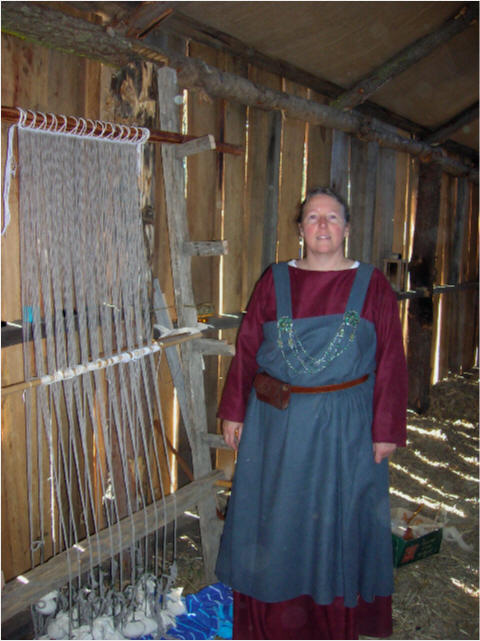
A couple of months ago, I agreed to set up and take a warp-weighted loom to the biennial Easter gathering hosted by the New England Medieval Arts Society (NEMAS), which is held in a wonderful pine forest setting about 10kms from Armidale. Several huundred reenactors come from all over Australia (and some from New Zealand) and camp out in an authentic setting for 4 days. I didn't camp out, but I was there all day Saturday and Sunday, setting up and demonstrating the loom, and also showing and teaching spinning on a drop spindle.
Preparing for the event took a lot of time. A friend and I built the loom, and then had to work out how to use it. I also had to make a costume for me, and adapt one for my niece, who came with her family from Canberra so that she could come to the event with me. (My costume is a rush job; one day I'll make a better, better fitting one!)
This weekend NEMAS had an open day for members of the public to come and see the long house and various demonstrations, so I took the loom out there again. As our first warp - which took us 3 hours to wind - didn't work too well at Easter, I wound another one with less hairy yarn during the week, and then my friend and I had to get that warp onto the loom this morning.
The whole experience was fun, although quite tiring; at least we have two years to recover and prepare for the next one!
I'll post some photos on my photoblog in the next day or so.
Thursday, March 30, 2006
Geoffrey Chaucer
I love the blogosphere. There are so many interesting, imaginative, talented people out there.
And now, Geoffrey Chaucer Hath a Blog. Yes, it's in Middle English (of sorts!) but it is well worth it - an absolute hoot!
And now, Geoffrey Chaucer Hath a Blog. Yes, it's in Middle English (of sorts!) but it is well worth it - an absolute hoot!
Fyghten togeder we dide, this valet and ich, in Rethel-toune whanne the Frensshe layde waste to yt to letten the Prince Noir from crossinge, and in the melee we were scatterede from the hoste, and we two dide runne like eye makeupe on a televangelistes wyf.
Monday, March 27, 2006
Mariner's tales
I spent a couple of hours yesterday dallying at the website Mariners and Ships in Australian Waters. This site includes transcripts of crew and passenger lists of ships arriving in Sydney in the latter half of the 19th century. With more than 700 ships a year arriving - from all over the world, including other Australian colonies - it was a busy, bustling port.
The historian in me loves these old records - and so does the novelist! The historian wants to pull the records into a database, so they can be sorted, analysed in an effective way. How often did individual ships make the journey to Sydney? Were crews relatively stable, the same men with the same masters?
The writer in me is constantly inspired - in this case, especially by the glimpses of women. Mrs James, wife of the Oliver Cromwell's captain, Donald James, made two voyages from the UK to Sydney on her husband's ship. James captained the ship for a number of years - are these two journeys that Mrs James made indicative of the early years of a marriage? Did she accompany her husband until she was pregnant with their first child, and afterwards stay at home, only seeing him in the short spaces between long voyages?
A captain's wife is one thing; but I'm also fascinated by mentions of women in the crew lists. They're not common, but they're not as rare as one might expect. Take, for example, Emma Lindsay. She was a crew member of the Salsette, which voyaged from Suez to Sydney three times in 1860. She was 33 years old, and listed as a stewardess - the only female crew member. The Salsette was a steamship of 965 tons, with a large crew - about 60 named crew on each trip, plus 100 or more merely listed as 'Asian'. In 1860, the Salsette docked at Sydney in January, July and October - and Emma is listed as crew each time. Passenger numbers ranged from 16 in January, to 31 in July, to '106 Asians' in October. In Aug 1861, the steamer arrived again, this time from Point de Galle, rather than Suez, and this time Emma is not listed; but there is a new stewardess, J.A. Corbett, aged 23.
What must it have been like, being the only woman in such a masculine environment? How did a youngish woman become a stewardess, and why? I did wonder if it was a euphemism for 'Captain's mistress', but given the way it's listed, in amongst the other crew, I doubt it. I also doubt the position translated to 'ship's whore'; if this was acceptable practice, then I'd expect more than one woman on the occasional ship.
Steam ships were a more luxurious way for passengers to travel, and presumably having a stewardess to assist the female passengers would have made the journey more tolerable for the ladies. In that circumstance, I'd guess that there would need to be at least some degree of propriety around the position in order for it to be acceptable.
I confess I'm fascinated by Emma and others; and yes, I can see a story line or 3! However, I can also see the need for more research - as always!
Update: I spent an hour in the uni library at lunchtime, reading microfilmed old newspapers, and I noticed on several adverts for ships travelling to London from Melbourne that 'a stewardess is on board for attendance on ladies'.
The historian in me loves these old records - and so does the novelist! The historian wants to pull the records into a database, so they can be sorted, analysed in an effective way. How often did individual ships make the journey to Sydney? Were crews relatively stable, the same men with the same masters?
The writer in me is constantly inspired - in this case, especially by the glimpses of women. Mrs James, wife of the Oliver Cromwell's captain, Donald James, made two voyages from the UK to Sydney on her husband's ship. James captained the ship for a number of years - are these two journeys that Mrs James made indicative of the early years of a marriage? Did she accompany her husband until she was pregnant with their first child, and afterwards stay at home, only seeing him in the short spaces between long voyages?
A captain's wife is one thing; but I'm also fascinated by mentions of women in the crew lists. They're not common, but they're not as rare as one might expect. Take, for example, Emma Lindsay. She was a crew member of the Salsette, which voyaged from Suez to Sydney three times in 1860. She was 33 years old, and listed as a stewardess - the only female crew member. The Salsette was a steamship of 965 tons, with a large crew - about 60 named crew on each trip, plus 100 or more merely listed as 'Asian'. In 1860, the Salsette docked at Sydney in January, July and October - and Emma is listed as crew each time. Passenger numbers ranged from 16 in January, to 31 in July, to '106 Asians' in October. In Aug 1861, the steamer arrived again, this time from Point de Galle, rather than Suez, and this time Emma is not listed; but there is a new stewardess, J.A. Corbett, aged 23.
What must it have been like, being the only woman in such a masculine environment? How did a youngish woman become a stewardess, and why? I did wonder if it was a euphemism for 'Captain's mistress', but given the way it's listed, in amongst the other crew, I doubt it. I also doubt the position translated to 'ship's whore'; if this was acceptable practice, then I'd expect more than one woman on the occasional ship.
Steam ships were a more luxurious way for passengers to travel, and presumably having a stewardess to assist the female passengers would have made the journey more tolerable for the ladies. In that circumstance, I'd guess that there would need to be at least some degree of propriety around the position in order for it to be acceptable.
I confess I'm fascinated by Emma and others; and yes, I can see a story line or 3! However, I can also see the need for more research - as always!
Update: I spent an hour in the uni library at lunchtime, reading microfilmed old newspapers, and I noticed on several adverts for ships travelling to London from Melbourne that 'a stewardess is on board for attendance on ladies'.
Subscribe to:
Posts (Atom)
